Key Metrics & Benefits
85%
FASTER P1/P2 TRIAGE
Reduced mean triage time from 20 minutes to 3 minutes.
40%
INCREASE IN PROCESSING CAPACITY
Expanded throughput without adding headcount.
100+
CUSTOMER ENVIRONMENTS
Stable triage decisions across tenants, shifts, and alert spikes.
85%
FASTER P1/P2 TRIAGE
Reduced mean triage time from 20 minutes to 3 minutes.
40%
INCREASE IN PROCESSING CAPACITY
Expanded throughput without adding headcount.
100+
CUSTOMER ENVIRONMENTS
Stable triage decisions across tenants, shifts, and alert spikes.
Scaling the MXDR Model Exposed Structural Gaps
As customer environments expanded, the SOC's operating model began to show strain - across speed, consistency, and governance.
100+ Customer Environments. Rising Alert Variability.
Alert volumes were growing across tenants, tooling stacks, and threat patterns — increasing operational entropy across the SOC.
P1/P2 Handling Was Too Slow and Unpredictable.
Manual triage variability made it difficult to consistently protect SLA margins during peak alert periods.
Expert Judgment Wasn’t Systematically Captured.
Critical decision logic lived inside senior analysts rather than being reusable, validated, or reinforced across teams.
Decision Quality Drifted Across Shifts.
Without structured validation and feedback loops, the same alert could produce different outcomes depending on the analyst.
Arcanna's Decision Layer Deployment
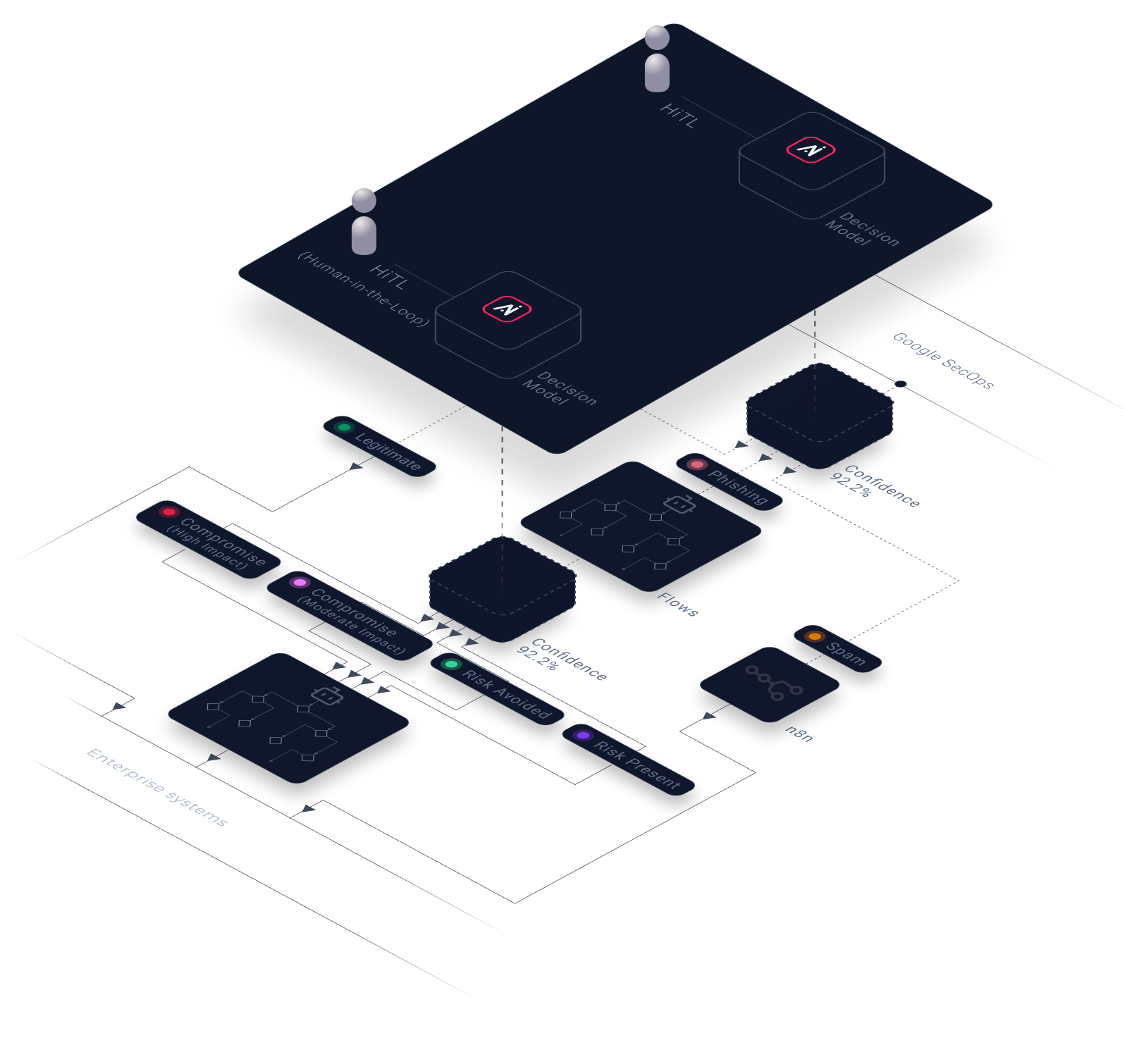
Arcanna introduced a Decision Layer on top of the provider’s existing MXDR workflows - enabling safe, predictable triage at scale across 100+ customer environments.
To operationalize analyst expertise, the provider deployed:
- 19 MITRE-aligned triage models
- Automated routing to the appropriate decision model
- Continuous learning from analyst feedback
- Guardrails: confidence thresholds, drift checks, full rollback
- Human-in-the-Loop (HITL) oversight
- Environment-aware modeling across tenants
Arcanna learns directly from historical analyst decisions, predicting with high reliability how senior analysts would handle similar alerts across diverse environments and contexts.
The result: predictable, explainable decisions across shifts, teams, and customer environments.